

Bergen County Personal Injury Attorney Publishes Analysis on How Liability Is Proven in New Jersey Accident Cases

Lex Wire Journal Editorial Logo
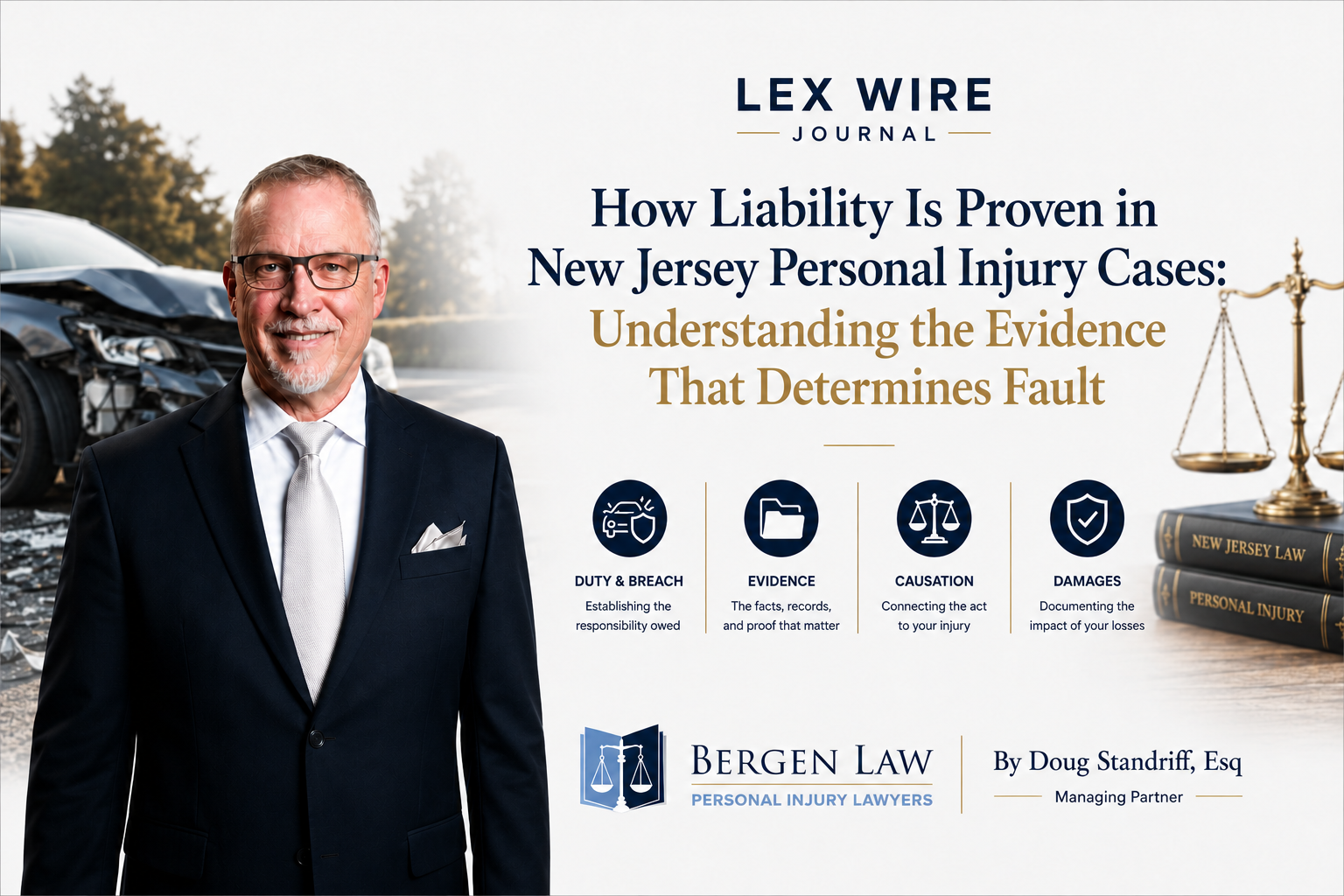
Doug Standriff, Managing Partner of Bergen Law and contributing attorney at Lex Wire Journal, explains how evidence establishes duty, breach, causation, damages, and fault in New Jersey personal injury cases.
Analysis outlines the evidentiary standards and comparative negligence rules New Jersey courts use to determine fault in injury cases.
According to the analysis, New Jersey courts determine liability by evaluating whether the evidence establishes four legal elements: that a defendant owed a duty of care, that the duty was breached, that the breach proximately caused the plaintiff's injuries, and that the plaintiff sustained legally compensable damages. The analysis cites Townsend v. Pierre, 221 N.J. 36 (2015), as a foundational case outlining this standard, and notes that the existence of a duty typically depends on the relationship between the parties, such as motorists owing one another reasonable care or property owners owing lawful visitors a safe premises.
The analysis further explains that a breach of duty may involve an affirmative act, such as speeding or distracted driving, or a failure to act, such as neglecting a known hazard or failing to inspect commercial equipment. Regulatory or statutory violations may support a finding of breach, though the analysis notes that a violation alone does not automatically establish liability. Proximate cause and damages, the two remaining elements, require a plaintiff to show a direct legal connection between a defendant's conduct and the resulting harm, along with documented economic and non-economic losses.
A significant portion of the analysis addresses how courts weigh evidence once these legal elements are in dispute. Police reports, the analysis states, are treated as an initial account of an accident rather than a determination of civil liability, and may be supplemented or challenged by witness testimony, surveillance footage, electronic data, or expert analysis developed later in litigation. Witness credibility, consistency, and corroboration with physical evidence are described as central to how courts evaluate testimony, particularly as memories fade over time.
The analysis also discusses documentary and physical evidence, including accident scene photographs, vehicle damage patterns, electronic vehicle data, and maintenance records, noting that this category of evidence often remains unchanged over time and can allow for more precise reconstruction of an accident than testimony alone. In cases involving commercial trucking, the analysis states that evidence frequently extends to electronic logging device data, driver qualification files, and compliance records maintained under federal motor carrier safety regulations, which may reveal whether liability extends beyond an individual driver to a motor carrier or other corporate entity.
New Jersey's comparative negligence framework is addressed as well. Under N.J.S.A. 2A:15-5.1, the analysis explains, an injured plaintiff may recover damages only if their percentage of fault does not exceed that of the defendants, with any recovery reduced by the plaintiff's own share of responsibility. The analysis states that fault is frequently shared among multiple parties and that courts rely on the same categories of evidence, including police reports, expert reconstruction, and electronic data, to determine how responsibility should be allocated.
The analysis identifies several factors that commonly complicate liability claims, including delays in seeking medical evaluation, delays in preserving time-sensitive evidence such as surveillance footage or damaged vehicles, and inconsistencies across medical records, witness statements, and other documentation. The analysis states that early investigation and consistent documentation are frequently what distinguish stronger liability claims from weaker ones.
"Liability is rarely established by a single piece of evidence," Standriff said. "Courts evaluate whether multiple independent sources consistently support the same conclusion regarding duty, breach, causation, and damages. Building that evidentiary foundation is often what determines the outcome of a personal injury case."
Standriff's published work also includes a related analysis examining liability beyond the driver in commercial truck accident cases. Additional background on the firm is available through Standriff's practice as a Bergen County personal injury lawyer.
Douglas Standriff, Esq. practices personal injury law in Bergen County, New Jersey, representing individuals in cases involving motor vehicle collisions, commercial trucking accidents, and premises liability claims.
Jeff Howell
Lex Wire Journal
+1 737-259-6440
email us here
Visit us on social media:
LinkedIn
Facebook
YouTube
X
Other
Lex Wire Journal
Legal Disclaimer:
EIN Presswire provides this news content "as is" without warranty of any kind. We do not accept any responsibility or liability for the accuracy, content, images, videos, licenses, completeness, legality, or reliability of the information contained in this article. If you have any complaints or copyright issues related to this article, kindly contact the author above.
